


 (706) 515-1995




Insurance company tactics often work behind the scenes to delay, reduce, or deny valid injury claims without a clear explanation. While insurance adjusters claim to help injured policyholders, many companies rely on subtle strategies that benefit their profits, not your recovery.
Knowing these tactics helps you recognize when an insurer crosses the line and when you need strong representation to protect your rights.
Contents
- 1 1. Delaying Your Claim With Information Requests
- 2 2. Offering Quick, Low Settlement Numbers
- 3 3. Blaming You to Reduce Liability
- 4 4. Scheduling Delayed Medical Evaluations
- 5 5. Denying Coverage for Ambiguous Policy Language
- 6 6. Offering Partial Payments Without Explanation
- 7 7. Using Recorded Statements Against You
- 8 8. Minimizing Your Injury Severity
- 9 9. Misrepresenting Policy Terms
- 10 10. Claiming No Witnesses or Evidence Exist
- 11 Protect Your Rights and Get the Compensation You Deserve
1. Delaying Your Claim With Information Requests
One of the most common insurance company delay tactics involves sending repetitive or vague requests for information, often after you’ve already supplied documents.
Adjusters may repeatedly ask for the same medical records or proof of expenses. They do this hoping you’ll become frustrated and give up. This common tactic buys time for insurers and may pressure you into accepting a low settlement simply to end the back‑and‑forth.
2. Offering Quick, Low Settlement Numbers
In addition, some insurers use aggressive insurance company settlement tactics by presenting a quick, lowball offer shortly after your claim. They may frame this amount as “the best we can do” or a “fair starting point,” even when your damages far exceed the number.
Accepting early offers often means forfeiting compensation for ongoing medical care, future lost wages, or long‑term disability.
3. Blaming You to Reduce Liability
Insurance adjusters know that if they can shift fault, they can reduce your payout. This insurance company tactics to reduce payouts method involves questioning your account of events or emphasizing minor errors in your statement to imply shared fault.
Even if you were not at fault, subtle wording or pressure may inadvertently lead you to weaken your claim.
4. Scheduling Delayed Medical Evaluations
Another strategy insurers use involves scheduling independent medical evaluations weeks or months after your accident. Doctors hired by the insurance company may conduct these exams.
Even if your injuries are severe, a delayed evaluation can make symptoms appear less significant. This insurance company delay tactics give adjusters leverage to argue that your injuries aren’t serious or related to the crash.
A credible explanation of these evaluations is available through the National Association of Insurance Commissioners, which notes concerns about conflict of interest in some independent examinations.
5. Denying Coverage for Ambiguous Policy Language
Insurers may claim that certain injuries or expenses fall under ambiguous language in your policy to deny coverage.
This approach is one of the most common insurance company tactics, often used to confuse policyholders and delay or reduce payouts. It forces injured people to fight over interpretations of complex wording just to recover the compensation they need.
Because most people sign policies without fully understanding exclusions, insurance companies can exploit these gaps to their advantage, pressuring victims into accepting less than they deserve.
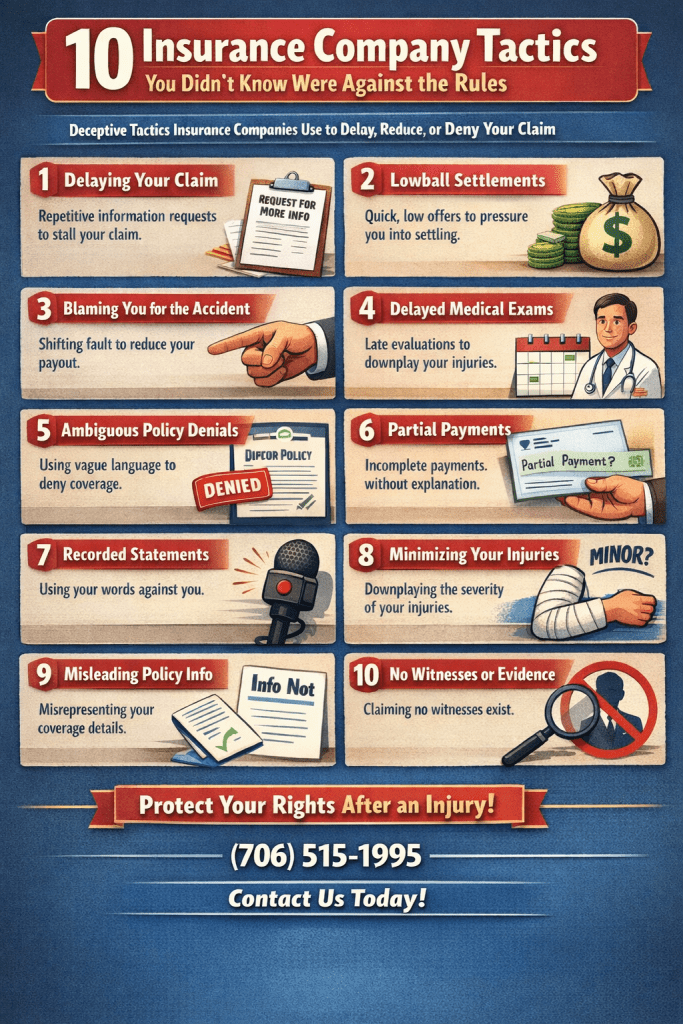
6. Offering Partial Payments Without Explanation
Some adjusters will issue partial payments without clearly explaining what is covered and what is not. This approach creates confusion and often prevents claimants from understanding whether they can negotiate the unpaid portion.
Partial payments without explanation are a subtle form of insurance company delay tactics, because injured people often wait for clarity that never comes.
7. Using Recorded Statements Against You
Insurers frequently request recorded statements from claimants and attempt to use these recordings to interpret your words in the least favorable way.
Even truthful answers can be taken out of context, misconstrued, or used to suggest inconsistency. Before giving any recorded statement, it’s important to understand your rights and speak with a legal professional.
8. Minimizing Your Injury Severity
Denial or downplaying of injuries is also among the most common insurance company dirty tricks.
After an accident, adjusters may insist that your injuries are “minor” or “pre‑existing,” even when medical records show otherwise. This tactic seeks to justify lower settlements and undermine your actual medical needs.
9. Misrepresenting Policy Terms
Another subtle but serious tactic involves misrepresenting the specifics of your own insurance policy, such as coverage limits, benefits, or exclusions. Insurers may tell you certain benefits aren’t available when, in fact, they are.
This method is one of the more aggressive auto insurance company delay tactics because it can steer you away from valid compensation entirely.
10. Claiming No Witnesses or Evidence Exist
Some adjusters will claim that no supporting evidence or witness testimony supports your story, even when such evidence does exist. This tactic may be used to discourage you from pursuing your claim further.
It’s important to document accident scenes, collect witness contact information, and keep records of all communications.
Protect Your Rights and Get the Compensation You Deserve
Insurance companies may use tricky strategies to delay or reduce your claim, but you don’t have to navigate this alone. When unfair insurance company tactics interfere with your recovery,
Appalachian Injury Law can help you stand up to these practices and pursue full compensation. Visit our Contact Us page or call (706) 515-1995 to speak with our team today.
